The best AI chatbot for a website can reduce this communication gap by answering questions, guiding visitors, capturing leads and transferring complex conversations to a person. However, the right platform depends on whether your priority is customer support, sales, ecommerce, CRM integration or simple no-code deployment.
This guide compares ten leading website AI chatbots available in 2026. The numbering makes the options easier to review, but it is not a universal ranking because each platform is designed for a different type of business.
What Should the Best Website AI Chatbot Do?
A modern website chatbot should do more than display scripted answers. It should understand naturally written questions, use reliable business knowledge and continue a conversation without forcing users through a fixed menu. Depending on your requirements, important features may include:
Training from website pages and documents
Natural and context-aware conversations
Lead or enquiry capture
Human handoff
Customer-support automation
Product and service guidance
Analytics and conversation history
CRM, help-desk or ecommerce integrations
Knowledge updates and response controls
Privacy and user-access settings
You do not necessarily need every feature. A small service business may only need a reliable website assistant, while an enterprise support team may require email, voice, ticketing, workflow automation and multiple departments.
1. Agent Best AI : Best for Building a Website-Trained AI Agent Without Coding
Agent Best AI is a strong AI chatbot development platform for businesses that want to create an assistant directly from their existing website. You enter your website URL and the platform scans products, services, FAQs, policies and other relevant business information. Additional PDFs, manuals, pricing documents and support resources can also be added to improve the agent’s knowledge. The completed AI agent can then be deployed through a website widget.
AgentBest.ai is designed to answer customer questions, guide website visitors, capture leads and support sales or customer-service conversations. It provides a practical alternative for businesses that want a professionally developed website chatbot without hiring a team to build the complete AI infrastructure from the beginning.
Best for: Small and growing businesses, ecommerce stores, SaaS websites, service companies and other organisations that want a no-code, website-focused AI agent.
Main strengths:
Learns directly from an existing website
Supports additional custom knowledge
Designed for support, sales and lead conversations
No custom API configuration required for basic setup
Suitable for multiple business industries
AgentBest.ai is particularly suitable when your main goal is turning website content into an interactive business assistant. Organisations needing a complete enterprise help desk across email, voice and large support departments may require a broader platform such as Zendesk or Intercom.
2. Chat base: Best for Flexible Customer-Facing AI Agents
Chatbase has developed beyond a basic website chatbot builder into a broader platform for customer-facing AI agents. Businesses can connect their data sources, define instructions and guardrails, test real scenarios and deploy agents across website chat, email, voice, WhatsApp, Slack and other channels. Its agents can support customer service, sales conversations and product guidance.
Chatbase also supports procedures and actions, allowing an agent to follow defined steps and interact with connected business systems. Its platform includes help-desk functionality, analytics, escalation review and tools for improving an agent after launch.
Best for: Growing businesses that need more control, multiple communication channels and automated actions.
Main strengths:
Support, sales and product-guidance agents
Multi-channel deployment
Actions and defined procedures
Testing and guardrail controls
Analytics and help-desk features
Chatbase provides more flexibility than a simple website FAQ bot, but businesses should expect to spend time configuring roles, actions and guardrails if they want to use its more advanced capabilities.
3. Tidio Lyro: Best for Small-Business Support and Live Chat
Tidio combines AI customer service, live chat and help-desk tools in one platform. Its Lyro AI agent understands conversational context, can adapt to a company’s tone and knows when a conversation should be escalated.
Lyro can be trained on business knowledge and connected to an existing help desk. It is designed to automate customer interactions while keeping human representatives available for situations the AI should not handle alone. Tidio also documents multilingual customer communication across more than 45 languages.
Best for: Small and medium-sized businesses that want AI automation alongside traditional live chat.
Main strengths:
AI and human live chat in one system
Context-aware customer conversations
Human escalation
Multilingual assistance
Help-desk integration
Tidio is especially useful for teams that still expect employees to participate in many conversations. Businesses wanting only a lightweight chatbot trained from a website may find some of its wider support tools unnecessary.
4. Intercom Fin: Best for SaaS and Established Support Teams
Fin is Intercom’s AI agent for customer service, sales and ecommerce conversations. For customer service, it answers questions and handles support across multiple channels. Fin for Sales engages and qualifies prospects, while its ecommerce role can assist shoppers with product recommendations and checkout guidance.
Fin can work across Intercom Messenger, email, WhatsApp, SMS, Facebook and Instagram. Businesses can train it using knowledge, policies, procedures and communication guidelines while managing AI and human representatives within the wider Intercom help-desk environment.
Best for: SaaS companies and established customer-support teams already using or considering Intercom.
Main strengths:
Strong customer-service automation
Sales and ecommerce roles
Multi-channel support
Knowledge and procedure management
Integrated AI and human-agent workspace
Fin is a powerful option for structured support operations, but it may be more platform than a small website needs when the main requirement is answering basic questions and capturing enquiries.
5. Zendesk AI: Best for Enterprise and Omnichannel Support
Zendesk AI is designed for businesses that manage customer service across several channels and departments. Its AI agents can work across messaging, email, voice, web forms and connected systems. Zendesk states that these agents can understand multi-step requests, execute approved actions and learn from support outcomes.
Zendesk combines AI agents with ticketing, live chat, knowledge management, reporting, quality assurance and tools for human representatives. This makes it more than a website chatbot: it is a complete service environment for businesses managing larger support operations.
Best for: Enterprises, contact centres and businesses already operating a structured support department.
Main strengths:
Omnichannel customer service
Advanced ticket and workflow automation
Multi-step AI resolutions
Human-agent support tools
Reporting and quality management
Zendesk is one of the most complete options in this list, but smaller businesses may prefer a simpler platform that can be launched and maintained with fewer resources.
6. HubSpot Customer Agent: Best for CRM-Centred Businesses
HubSpot’s Customer Agent is closely connected to its CRM and wider marketing, sales and service platform. The agent can answer customer questions using existing business content, qualify leads and route support requests. Because it works with HubSpot customer data, it can provide more contextual assistance across marketing, sales and service processes.
HubSpot also allows businesses to manage ready-made and custom agents through Agent Hub. Its Customer Agent can be assigned to support channels and respond conversationally using available contextual knowledge.
Best for: Businesses that already manage contacts, marketing, sales or support through HubSpot.
Main strengths:
Direct CRM context
Lead qualification
Customer-question resolution
Ticket routing
Connected marketing, sales and service data
HubSpot is a logical choice for existing HubSpot users. A company that does not need its CRM or broader go-to-market tools may find a specialised chatbot platform easier to manage.
7. Botsonic: Best for Affordable No-Code Chatbot Deployment
Botsonic is a no-code platform for building AI chatbots from websites, files and help-centre content. The platform is positioned for customer support, sales, employee assistance and conversational commerce. Users can upload knowledge sources and create a website chatbot without developing the underlying AI system themselves.
Botsonic also supports integrations and custom actions for businesses that want the chatbot to connect with additional workflows rather than only answer questions.
Best for: Startups, smaller teams and businesses seeking a lower-cost entry into website AI chatbots.
Main strengths:
No-code chatbot creation
Website and document training
Customer-support and sales use cases
Knowledge-source management
Custom actions and integrations
Botsonic is attractive for quick deployment and basic automation. Businesses should compare message allowances, integrations and support features carefully as their conversation volume grows.
8. Site GPT: Best for Content-Driven Websites and Lead Generation
SiteGPT creates an AI customer-support agent trained on a company’s website and additional content. Businesses can enter a website URL, upload files or add raw text. The chatbot can then be embedded on marketing websites, applications or help centres. SiteGPT also provides automatic content syncing on supported plans to keep the chatbot aligned with website changes.
Its platform includes human escalation, lead capture, analytics, quick conversation prompts and integrations with tools such as Slack, Crisp and Zendesk.
Best for: Content-heavy websites, online services, documentation websites and businesses focused on support plus lead generation.
Main strengths:
Website, file and connected-source training
Human escalation
Lead collection
Automatic content syncing
Conversation analytics
SiteGPT is especially practical when most customer questions can be answered from existing content. Businesses needing complex transactions or highly customised workflows should confirm whether the required integrations are available.
9. Docs Bot AI: Best for Documentation and Knowledge-Heavy Websites
DocsBot turns business documentation and knowledge bases into customer-facing or internal AI agents. Its agents can provide answers from approved content, cite their sources, take actions through connected tools and escalate conversations when human help is required.
This makes DocsBot useful for software documentation, technical products, education, internal knowledge and support environments where users need accurate answers from a large collection of information.
Best for: SaaS documentation, technical businesses, knowledge bases and internal employee assistance.
Main strengths:
Knowledge-base training
Source-supported answers
Customer and internal agents
Human escalation
Workflow actions and integrations
DocsBot may be more specialised than necessary for a small brochure website. Its greatest value appears when a business has substantial documentation that customers or employees need to search regularly.
10. Custom GPT AI: Best for White-Label and Source-Cited Chatbots
Custom GPT AI allows businesses and agencies to create branded AI chatbots from approved website content and documents.The platform emphasises source-grounded responses with citations, allowing users to see where an answer came from. Chatbots can be embedded on websites, portals or custom interfaces, with branding and deployment options depending on the selected plan.
CustomGPT.ai is also designed for agencies and SaaS businesses that may need separate agents, branded client experiences, APIs or white-label deployments.
Best for: Agencies, consultants, enterprise knowledge use cases and businesses requiring source visibility or branded deployment.
Main strengths:
Source-cited answers
Website and document knowledge
No-code website embedding
White-label options
API and custom-interface support
CustomGPT.ai is a strong choice where verification and branding are priorities. Businesses should confirm exactly which white-label, API and custom-domain features are included in their required plan.
Which AI Chatbot Is Best for Your Website?
There is no single chatbot that is best for every business.
Choose Agent Best AI when you want a no-code website-trained agent for support, visitor guidance, lead capture and sales conversations without starting a custom development project.
Choose Chatbase when you need flexible customer-facing agents with actions and multi-channel deployment.
Choose Tidio Lyro when live chat and small-business customer support are central to your strategy.
Choose Intercom Fin or Zendesk AI when you operate a larger support environment with multiple channels, workflows and human representatives.
Choose HubSpot Customer Agent when your customer conversations need to connect directly with your HubSpot CRM.
Choose Botsonic when affordability and quick no-code deployment are priorities.
Choose SiteGPT when your chatbot will rely heavily on website content and lead capture.
Choose DocsBot AI when documentation and knowledge-base accuracy are your main concerns.
Choose CustomGPT AI when you need source citations, client branding or white-label deployment.
How to Compare AI Chatbots Before Choosing One
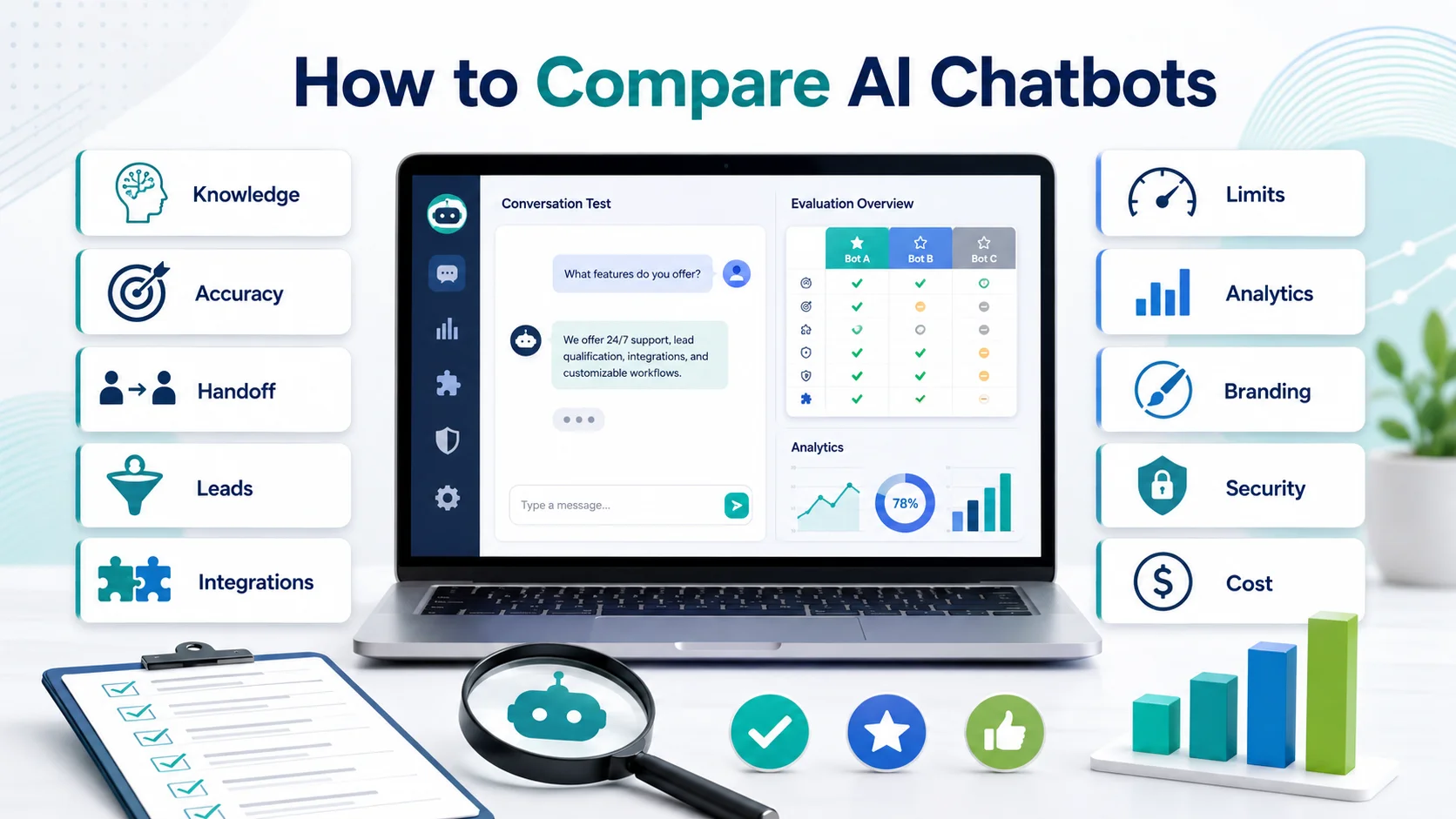
Before selecting a platform, test it with real questions from your customers rather than relying only on a polished demonstration. Check whether the chatbot can accurately answer questions from your content, understand follow-up messages and admit when reliable information is unavailable. You should also test spelling mistakes, incomplete questions and requests that must be escalated. Review the following areas before making a decision:
Knowledge sources and update process
Answer accuracy
Human-handoff options
Lead-capture features
Integrations
Conversation limits
Analytics
Branding controls
Security and privacy
Total cost as usage grows
A chatbot with more features is not automatically better. The right option is the one that solves your specific website communication problem without becoming difficult to manage.
Final Thoughts
The best AI chatbot for a website should make it easier for visitors to understand your business and receive help. For a small or growing company, a website-trained platform such as AgentBest.ai may provide the most direct route from existing content to a working support and sales assistant. Larger organisations may benefit from the wider help-desk environments offered by Intercom, Zendesk or HubSpot.
Whatever platform you choose, success depends on more than the software. Your website information must be accurate, your chatbot must have clear boundaries and customers must be able to reach a person when automation is not enough. The strongest AI chatbot is not the one that gives the most answers. It is the one that gives reliable answers, supports the customer’s next step and knows when a human should take over.
Disclosure: This article is published by AgentBest.ai, which is included in the comparison. The product descriptions below are based on publicly documented capabilities available in August 2026.