A self service chatbot helps customers find answers and complete simple support tasks without waiting for a person. When implemented correctly, it reduces repetitive work while keeping human support available for complaints, exceptions, sensitive issues and complex decisions.
What Is a Self Service Chatbot?
A self service chatbot is an automated conversational tool that helps customers find information, solve routine problems and follow support processes independently.
Instead of searching through a large help centre or waiting in a support queue, the customer can describe the problem in their own words. The chatbot then uses approved information from FAQs, policies, website pages, product details, manuals or support documents to provide a relevant response. For example, a customer may ask: “Can I exchange an item if I opened the packaging?” The chatbot can retrieve the company’s actual exchange policy and explain the correct process.
Traditional self-service mainly relied on static FAQs, knowledge bases and fixed chatbot menus. Modern AI self-service tools can better understand intent, respond to follow-up questions and provide more contextual guidance.
How a Self Service Chatbot Reduces Support Work
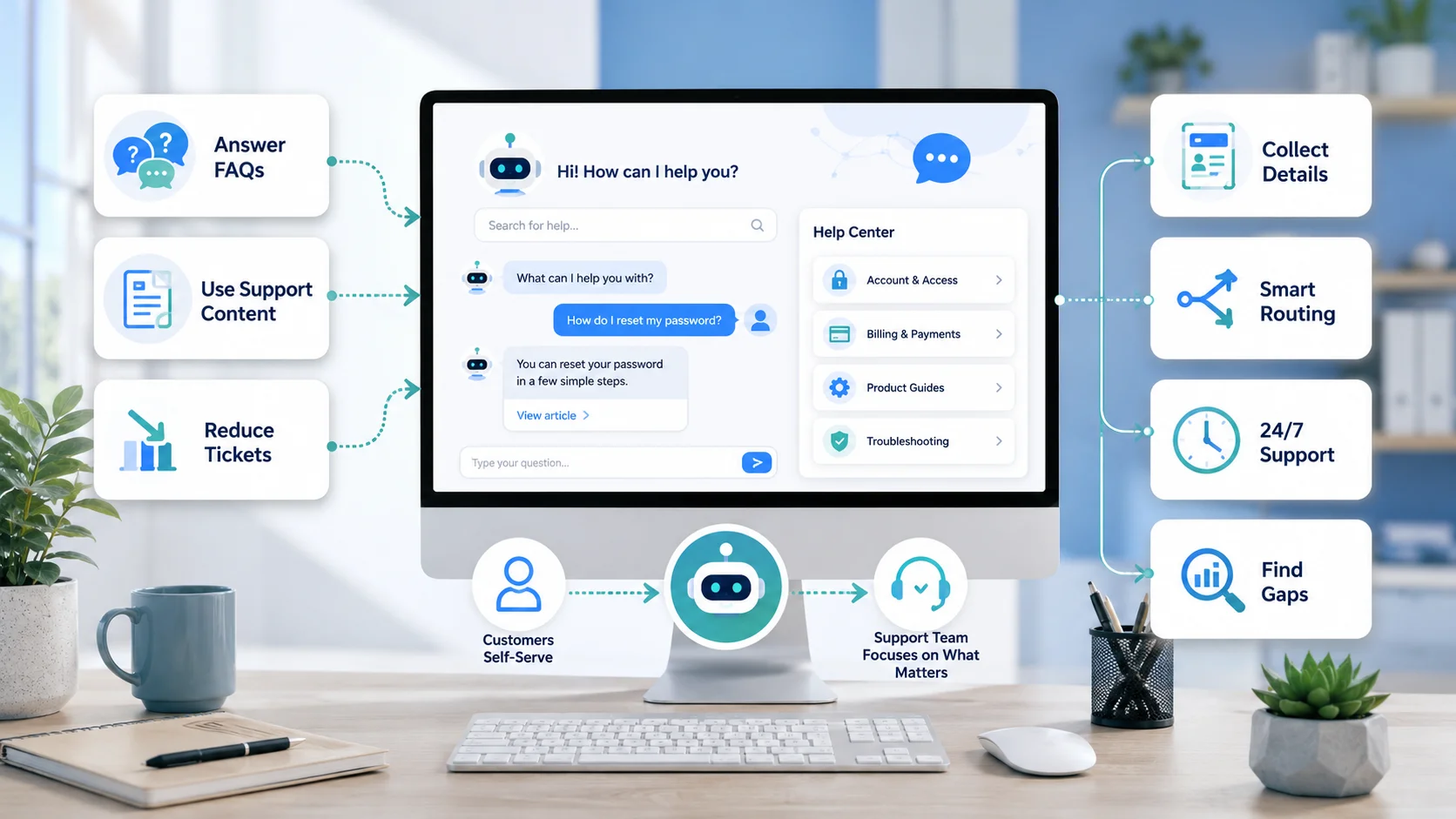
It Answers Repeated Questions Immediately
Routine questions often create a large part of a support team’s daily workload. Customers may repeatedly ask about delivery times, returns, account access, pricing, business hours, product compatibility, cancellations or service availability. A chatbot can answer these questions using approved business information.
This does not remove the importance of the question. It simply removes the need for an employee to manually provide the same answer every time. Support representatives can then spend more time on cases involving unusual circumstances, technical investigation, negotiation or personal attention.
It Makes Existing Support Content Easier to Use
Many businesses already have the information customers need. The problem is that it may be spread across FAQs, help articles, policy pages, manuals and product documentation. A chatbot creates a conversational way to access this content.
Instead of searching through several pages, the customer can ask: “How do I add another user to my account?” The chatbot can provide the approved steps or direct the user to the most relevant guide. This makes the knowledge base more useful without requiring the customer to understand how the website is organised.
It Reduces Unnecessary Support Tickets
Customers often create tickets because they cannot quickly find an answer, not because the issue genuinely requires a support representative. When a chatbot can explain a standard process clearly, some customers can resolve the issue before submitting a ticket. For example, the chatbot may explain how to reset a password, locate an invoice, update a profile, start a return or find setup instructions.
Self-service software is designed to let customers access information and resolve suitable issues independently, reducing routine work for support teams while keeping assistance available continuously.
However, businesses should measure successful resolutions rather than simply counting how many tickets were avoided. Preventing a ticket is not useful if the customer leaves without solving the problem.
It Collects Information Before Human Handoff
Some conversations begin with a simple question but eventually need a person. A self service chatbot can collect the basic details before transferring the request. Depending on the situation, this may include the customer’s name, contact information, account or order number, product involved and a short explanation of the issue.
The support representative then receives a more complete case instead of starting with an empty message such as “I need help.” A useful handoff should also include the previous conversation so the customer does not have to repeat everything. Modern AI self-service systems increasingly pass conversation summaries and relevant context to human representatives during escalation.
It Routes Requests to the Correct Team
A single support channel may receive billing questions, technical problems, return requests, sales enquiries and account issues. A chatbot can identify the general subject of the conversation and send it to the appropriate team.
For example, a payment question can go to billing, a product fault to technical support and a return exception to a customer-service representative with the authority to review it. Better routing reduces the time employees spend reading, forwarding and reassigning requests.
It Provides First-Line Support Outside Working Hours
Customers may need help during evenings, weekends, holidays or from another time zone. A chatbot can answer suitable questions when employees are unavailable. It may resolve the issue immediately, direct the customer to a useful resource or collect information for later follow-up.
Modern customer-service chatbots are commonly used to provide instant support across websites and other digital channels while escalating cases that need human assistance. The chatbot should still set realistic expectations. It should not suggest that a human team is available immediately when the request will not be reviewed until the next working day.
It Reveals Gaps in Your Support Content
Chatbot conversations can show what customers struggle to understand. If many users repeatedly ask about the same return condition, product feature, setup step or billing process, the business may need to improve the original information. A chatbot may reveal:
Questions with no reliable answer
Policies customers find confusing
Help articles that are difficult to locate
Products causing repeated support requests
Common reasons for human escalation
Information that has become outdated
The best solution is not always to automate the same answer forever. Sometimes the website, product page, policy or support process should be improved.
What Can a Self Service Chatbot Handle?
A chatbot is best suited to clear, repeated requests that have reliable answers or defined steps. Common uses include product and service questions, delivery information, return policies, password-reset guidance, account instructions, appointment procedures, basic troubleshooting, onboarding support, website navigation and support-ticket collection.
More advanced systems may also complete approved actions when connected to the required business tools. For example, an integrated system may help process a return or update a ticket. However, businesses must clearly distinguish between explaining a process and actually completing it. A chatbot should never claim that an order, refund, appointment, or account has been updated unless the action was successfully completed through an authorised integration.
How Self-Service Chatbots Help Ecommerce Stores
Ecommerce stores receive many repetitive questions before and after purchases. Before ordering, shoppers may ask about sizing, materials, compatibility, delivery times, payment methods or return conditions. After ordering, they may need help with tracking procedures, exchanges, damaged products or missing packages.
For example, a shopper might ask: “Can I return these shoes if I ordered the wrong size?”
The chatbot can explain the store’s published return policy and direct the shopper to the correct process. It may also help customers compare product information, find relevant collections, understand store policies or locate support pages.
Accessing a specific order, checking live inventory or processing a refund requires suitable integrations and customer verification. Without those connections, the chatbot should provide general guidance and offer human assistance when necessary.
What Should Not Be Fully Automated?
Self-service should not become a barrier between customers and your team. Some situations require judgment, empathy, authority or specialist knowledge. These normally include:
Emotional complaints
Payment disputes
Unusual refund requests
Sensitive account concerns
Legal or regulated questions
Serious technical problems
Custom negotiations
Decisions requiring management approval
The chatbot may collect initial details, but the final decision should be handled by an appropriate person. Customers should also be able to ask for human assistance directly. A chatbot that repeatedly blocks escalation may reduce ticket volume while damaging customer trust.
How to Set Up a Self Service Chatbot
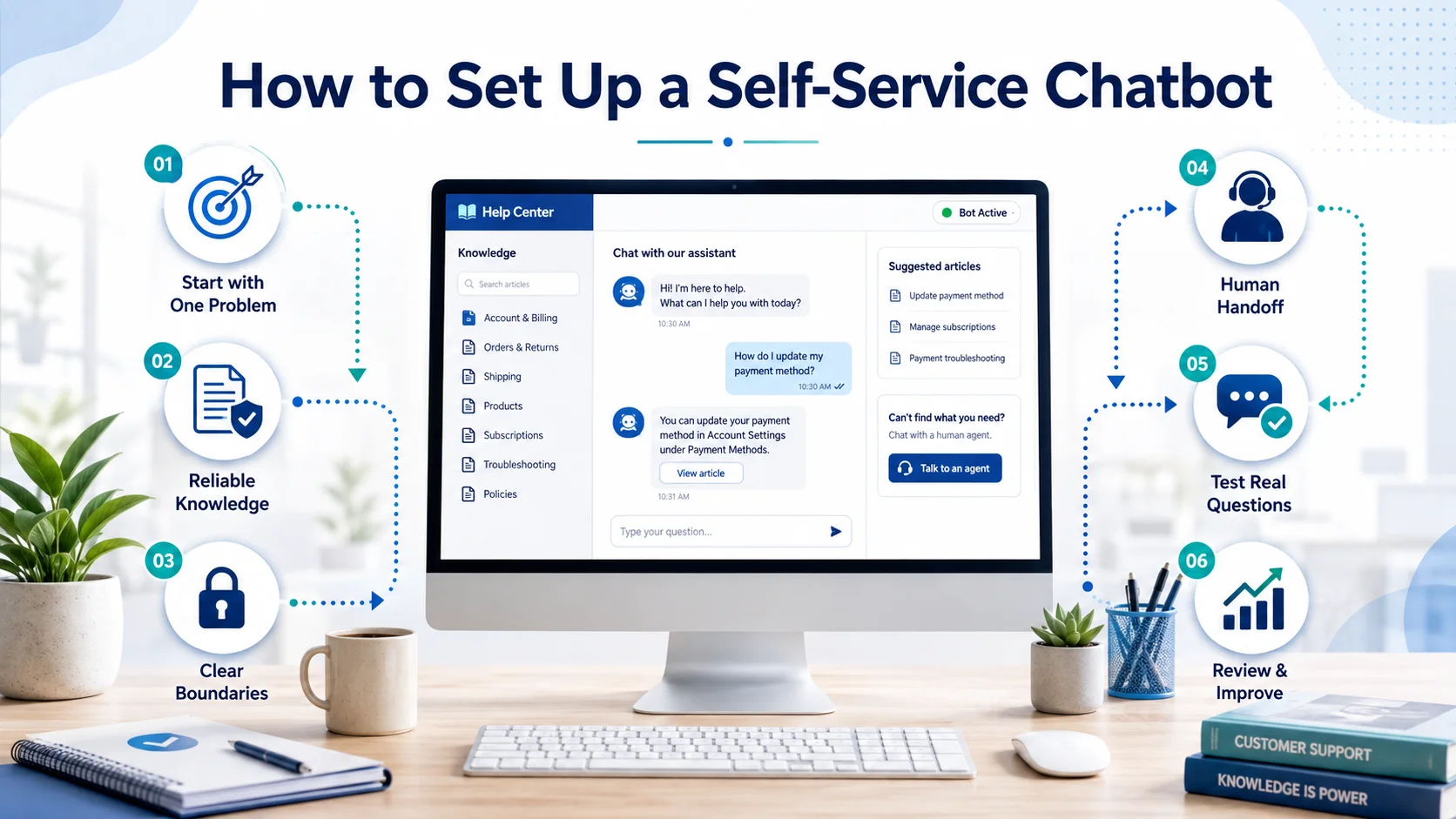
Begin With One Clear Support Problem
Do not try to automate the entire customer-service operation immediately. Start with a focused issue such as repeated FAQs, ecommerce policy questions, basic account guidance or support outside working hours. A specific objective makes the chatbot easier to train, test and measure.
Prepare Reliable Support Knowledge
Review the website pages, FAQs, manuals, policies, product information and help articles the chatbot will use. Remove outdated, duplicated or contradictory information. If two documents provide different answers, the chatbot may not know which one is correct. The quality of self-service depends directly on the quality of its knowledge.
Define Clear Boundaries
Decide what the chatbot may answer, what information it can collect and which situations require human support. It should not invent policies, prices, account information, technical instructions or delivery promises. When it cannot find a reliable answer, it should clearly admit the limitation and provide a useful next step.
Design Human Handoff Early
Escalation should not be added as an afterthought. Define when the chatbot should transfer a conversation, which team should receive it and what information should be included. The customer should not have to repeat the complete issue after the transfer.
Test Real Customer Questions
Do not test only carefully written questions. Use spelling mistakes, short messages, unclear wording, follow-up questions, complaints and requests outside the chatbot’s approved knowledge. Testing realistic language helps reveal where the chatbot may misunderstand customers or provide incomplete guidance.
Continue Reviewing Conversations
A self service chatbot is not a tool that should be installed and forgotten. Its knowledge must be updated whenever products, prices, policies, services or support processes change. Businesses should also review unresolved questions and repeated escalations to identify areas for improvement.
How to Measure Whether It Reduces Support Work
Avoid measuring success only by the number of automated conversations. Useful performance indicators include:
Questions resolved without human assistance
Support tickets created after a chatbot conversation
First-response time
Human-handoff rate
Repeat contacts about the same issue
Incorrect or outdated answers
Customer satisfaction
Time saved for representatives
Most common unresolved questions
A lower automation rate with accurate answers and smooth handoff may be more valuable than a high automation rate that leaves customers frustrated.
The goal is not simply fewer tickets. It is fewer unnecessary tickets and faster resolution for the customers who still need help.
How Agent Best AI Supports Customer Self-Service
Agent Best AI helps businesses create a self-service support chatbot using their existing website content and additional knowledge. The platform can learn from website pages, products, services, FAQs, policies, pricing details, manuals and uploaded support documents.
Businesses can then deploy the chatbot through a website widget so customers can ask questions and receive answers based on that business-specific information. Agent Best AI also supports natural conversations, knowledge updates, conversation analytics and human handoff when a request needs personal assistance.
For an ecommerce store, this may involve product, shipping, return and exchange questions. A SaaS company may use it for onboarding and basic account guidance, while a service business may use it to explain processes and collect support details. The business remains responsible for maintaining accurate knowledge and deciding which conversations should be transferred to its team.
Final Thoughts
A self service chatbot reduces support work by helping customers resolve straightforward issues independently. It can answer repeated questions, make support content easier to use, reduce unnecessary tickets, collect case information, route requests and provide first-line assistance outside normal working hours.
But effective self-service is not about preventing customers from speaking with people. It is about giving them a faster option for simple needs while keeping human help visible and accessible. The best self service chatbot handles what is clear, recognises what is not and transfers the conversation before automation becomes frustrating.