A company wants an AI chatbot. The first requirement is simple: “Visitors should be able to ask questions about our products and services.” Then someone adds: “It should also appear inside our customer portal.”
Another person says: “It needs to recognize logged-in customers, check account permissions, query our internal database, update CRM records, create support tickets, and follow our own workflow.”
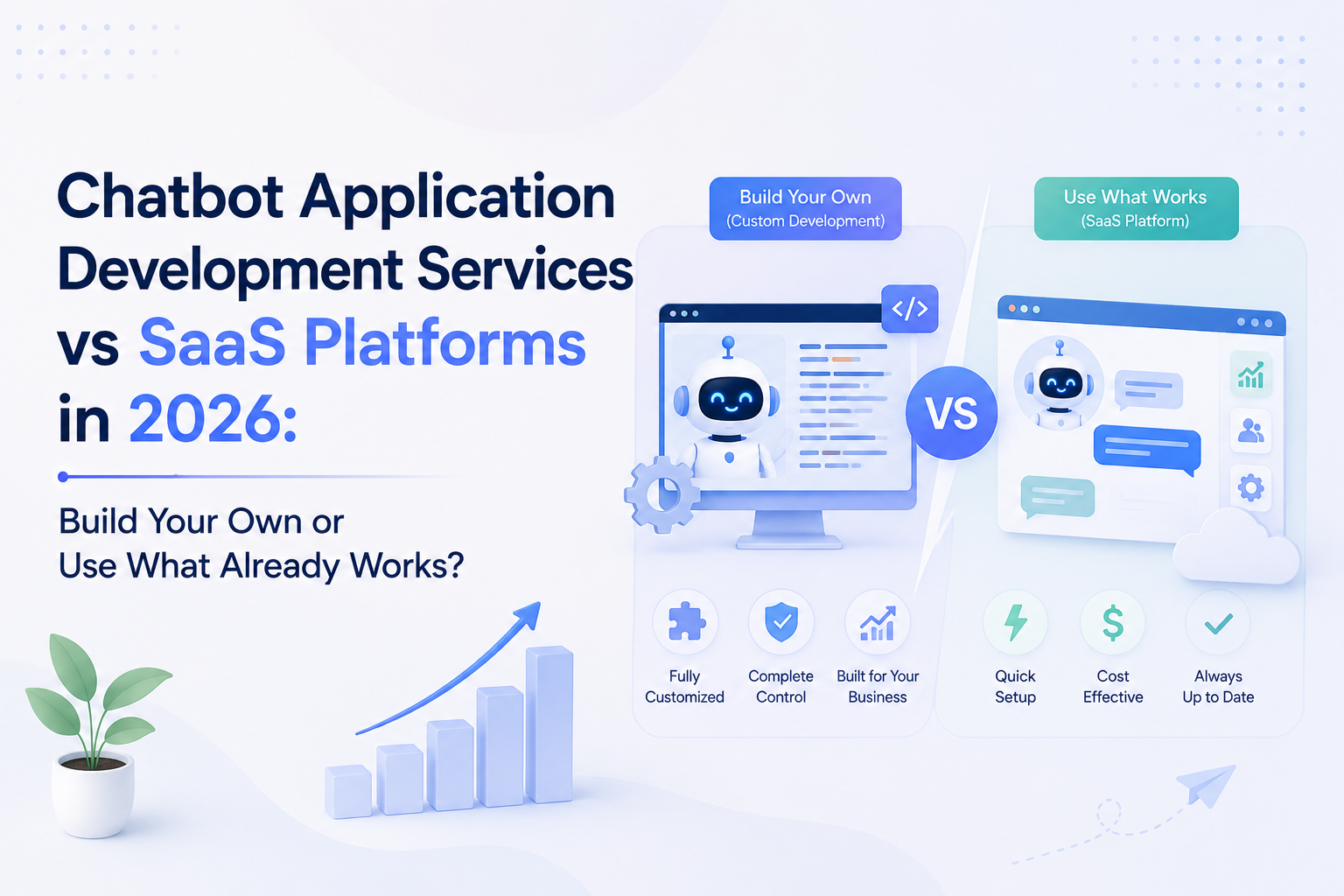
Suddenly, you are not deciding which chatbot widget to install. You are deciding whether to build a software application. That is the real difference between chatbot application development services and a SaaS chatbot platform.
A SaaS platform gives you an existing product with much of the underlying AI, knowledge management, hosting, interface, analytics, security, and deployment infrastructure already built. Custom application development gives you more control over how those pieces work, but your business also takes on considerably more development, testing, maintenance, and operational responsibility.
The financial difference can be substantial. Current Clutch data says custom chatbot projects may start with minimum project sizes around $1,000 to $10,000 for focused work or proofs of concept, while enterprise-grade implementations can reach $100,000 to $250,000 or more. Clutch also puts many custom chatbot projects around 8 to 12 weeks, with integrations, proprietary data, compliance requirements, and testing increasing the timeline.
At the same time, SaaS platforms have become much more capable. Chatbase, for example, currently combines knowledge, integrations, analytics, API access, AI actions, helpdesk capabilities, voice, and enterprise controls depending on the plan.
Voiceflow provides managed production environments, integrations, observability, and agent workflows without requiring customers to build the entire platform underneath. So the question is not: “Is custom development better than SaaS?” It is: “Which parts of our chatbot genuinely need to be custom?” That is what this guide will help you answer.
What Are Chatbot Application Development Services?
Chatbot application development services involve designing and building a chatbot or AI agent as a custom software application around the requirements of a specific organization.
The work may include the customer-facing interface, backend services, business logic, AI model integration, knowledge retrieval, databases, authentication, APIs, workflow automation, analytics, security, deployment, and ongoing maintenance.
In a relatively simple project, developers might build a branded chatbot inside an existing website or mobile application. In a more advanced project, the chatbot could become part of the company's product architecture.
For example, a SaaS company might want an assistant inside its customer dashboard that can identify the logged-in user, understand their subscription level, search product documentation, check account settings, perform approved changes, and create a support ticket when it cannot resolve the issue. That is an application. It needs to work with the rest of the software, not simply sit beside it.
What Is a SaaS Chatbot Platform?
A SaaS chatbot platform provides an existing cloud-hosted application that businesses configure instead of building from scratch. The provider has already developed much of the underlying infrastructure. Depending on the platform, that may include:
- AI model connectivity
- Website crawling
- Knowledge management
- File uploads
- Chat interface
- Hosting
- Analytics
- User management
- Integrations
- Human handoff
- Security controls
- Software updates
For example, Agent Best AI lets a business enter its website, build knowledge from pages, services, products, FAQs, policies, and other content, upload additional documents, and deploy an AI assistant through a website widget without developing the complete chatbot platform itself. That is the SaaS advantage in one sentence: You configure a system that already exists instead of funding the creation of the entire system.
Custom Chatbot Application vs SaaS Platform at a Glance
| Area | Custom Chatbot Application | SaaS Chatbot Platform |
|---|---|---|
| Initial investment | Usually much higher | Usually much lower |
| Launch time | Often weeks or months | Often hours or days |
| Application ownership | Potentially high, depending on contract | Provider owns core platform |
| Source-code control | Possible | Usually limited |
| Interface flexibility | Very high | Limited to platform options |
| Proprietary integrations | Strong flexibility | Depends on native integrations and API |
| Authentication | Can be built around your system | Depends on platform capabilities |
| Hosting | Your responsibility or development partner's | Managed by SaaS provider |
| Maintenance | Your team or vendor | Core platform maintained by provider |
| Model flexibility | Can be designed specifically | Depends on provider |
| Security architecture | Highly customizable | Based on provider controls |
| Analytics | Fully customizable | Built-in, with plan limitations |
| Best for | Unique product and workflow requirements | Common website, support, sales, and knowledge use cases |
The key trade-off is simple. Custom gives you control. SaaS removes work. Neither advantage is free.
Where Custom Chatbot Application Development Actually Makes Sense
The easiest way to make this decision is to look at what the chatbot needs to become inside your business.
1. The Chatbot Is Part of Your Product
A website chat bubble can usually be handled through SaaS. An AI assistant deeply embedded inside your application may be different. Imagine a project-management SaaS company.
The assistant appears beside the customer's projects and can answer:
- “Which tasks are overdue?”
- “Summarize everything that changed this week.”
- “Create a follow-up task for Sarah.”
- “Move all unresolved bugs into the next sprint.”
The interface, permissions, context, and actions are tied directly to the product. Building this experience may require:
- Product UI integration
- User authentication
- Workspace permissions
- Internal APIs
- Custom actions
- Application-specific context
- Audit logs
- Error handling
This is where chatbot application development services can provide meaningful value. You are not creating a generic support chatbot. You are extending your software product.
2. You Need a Completely Custom Interface
Most SaaS chatbot platforms give you a configurable widget. You may be able to adjust branding, position, welcome messages, and some conversation behaviour. That is enough for many businesses. But imagine the AI needs to live:
- Inside a customer dashboard
- Next to analytics charts
- Inside a product configurator
- Within a mobile application
- Beside an internal CRM record
- Inside proprietary desktop software
A floating chatbot widget may not fit. A custom application gives your product and UX team more freedom to decide exactly how AI should appear. The chatbot does not even have to look like a chatbot. It could appear as an inline assistant, contextual action panel, search experience, or command interface.
3. Your Business Logic Is Unique
This is one of the strongest reasons to build custom software. Suppose a shipping company wants an AI assistant to handle delivery-change requests.
The workflow requires the system to identify the customer, retrieve the shipment, inspect contract terms, check customs status, determine whether the destination can be changed, calculate an additional charge, request approval when necessary, update the logistics platform, and record the result.
That workflow may be unique to the company. A generic SaaS chatbot cannot reasonably provide a prebuilt workflow for every internal process used by every business. When the business logic itself is proprietary, custom application development becomes easier to justify.
4. You Have Proprietary Internal Systems
Modern SaaS chatbot platforms can connect with common tools such as CRM systems, ecommerce platforms, helpdesks, Slack, WordPress, and automation tools. But your most important system may not be common. Perhaps your business uses:
- A proprietary ERP
- An internally built CRM
- A legacy warehouse system
- A specialized booking platform
- A private customer database
- Industry-specific operational software
If the chatbot needs deep access to these systems, developers may need to create custom APIs, middleware, authentication, data mapping, and workflow logic. This is another area where application development can be more appropriate than forcing the workflow into a standard SaaS platform.
Where a SaaS Chatbot Platform Usually Makes More Sense
The opposite situation is just as important. Many businesses consider custom development even though their actual needs are already solved.
1. The Chatbot Mainly Needs Business Knowledge
Suppose visitors usually ask:
- “What services do you offer?”
- “Which pricing plan includes automation?”
- “Do you integrate with Shopify?”
- “What is your return policy?”
- “Can someone contact me?”
The chatbot mainly needs access to business knowledge. That knowledge may already exist across:
- Website pages
- FAQs
- Product information
- Pricing pages
- Policies
- PDFs
- Support documentation
A SaaS platform can often turn this content into usable AI knowledge without requiring your business to commission a retrieval system from scratch. Agent Best AI, for example, currently crawls website pages, products, services, FAQs, policies, pricing information, and other public content.
Businesses can also add PDFs, manuals, support documents, and additional knowledge before deploying the chatbot. If that covers most of your requirements, custom development may add very little value.
2. You Need Customer Support and Human Handoff
A common business requirement is: Automate straightforward questions, but let a person take over when necessary. That is already a standard SaaS capability on many modern platforms.
Agent Best AI currently supports human escalation while preserving conversation context and can route relevant conversations to team members. It also provides WordPress, Shopify, Slack, email, API, Zapier, and custom integration options.
You should not automatically build these components yourself simply because they are important. First determine whether an existing platform already implements them reliably.
3. You Need to Validate the Idea Quickly
Perhaps your company believes customers would use an AI assistant. You do not yet know. Building a six-figure application before proving that assumption creates unnecessary risk. A SaaS platform lets you test questions such as:
- Do visitors open the chatbot?
- What do they ask?
- Can AI answer accurately from our content?
- Which conversations require human help?
- Do customers use product recommendations?
- Does the chatbot capture useful enquiries?
If the experiment works, you can expand. If it does not, you have not spent months developing a custom system. This is often the strongest reason to start with SaaS even when custom development may eventually make sense.
Custom Development Gives You More Control Over Architecture
Control is where custom application development has a real advantage. Your development team can potentially choose the foundation model, retrieval architecture, databases, hosting, interfaces, authentication system, integrations, caching strategy, logging, analytics, and deployment environment.
Modern managed infrastructure can still be used inside a custom solution. For example, Amazon Bedrock Knowledge Bases can manage ingestion, indexing, storage, retrieval, embeddings, reranking, and other RAG infrastructure while still letting developers build their own application around the service.
This is important because “custom application” does not mean your developers should reinvent every technical component. A sensible custom stack might use managed AI infrastructure for the difficult commodity pieces while keeping the business-specific application layer custom. That can reduce development and operations work substantially.
Custom Does Not Have to Mean Building Your Own AI Model
This is another misconception. Most businesses commissioning chatbot applications do not need to create a foundation model. They need to build an application around existing models. The application may combine:
Foundation model + business instructions + knowledge retrieval + customer context + APIs + permissions + user interface
This is very different from training an LLM from scratch. Amazon's current agent architecture illustrates the same principle.
Agents can coordinate foundation models, data sources, APIs, and user conversations, while knowledge bases provide additional proprietary information. For most custom chatbot projects, orchestration and integration matter more than owning the underlying model.
SaaS Platforms Trade Architectural Control for Convenience
When you use SaaS, the provider decides much of the underlying architecture. That can limit your options. You may have less control over:
- Model selection
- Hosting location
- Retrieval architecture
- Data structure
- Interface
- Deployment method
- Logs
- Update schedule
- API capabilities
- Retention policies
On the other hand, you also do not have to build and operate those systems. That trade-off can be very attractive. For example, Chatbase currently offers plans that bundle AI models, knowledge, integrations, analytics, auto-retraining, API access, helpdesk functionality, telephony, and enterprise controls depending on the tier.
Voiceflow similarly provides hosted development, staging, and production environments along with observability and integration tooling. The SaaS provider handles product development across many customers. Your team focuses on configuring the platform for your use case.
Cost: The Difference Can Be Much Larger Than It First Appears
This is usually where businesses begin comparing options. Current Clutch data says custom chatbot projects range widely. Minimum project sizes may start around $1,000 to $10,000 for focused builds or proofs of concept, while enterprise-grade systems can reach $100,000 to $250,000 or more. $50 to $99 per hour is currently a common rate band for established AI development firms listed on the platform.
A SaaS platform usually replaces the initial development bill with recurring subscription and usage costs. For example, Chatbase currently lists monthly plans at $40 for Hobby, $150 for Standard, and $500 for Pro, with additional message credits and other add-ons available separately.
Agent Best AI currently lists plans from $49 per month and provides a 14-day free trial without requiring a credit card. That makes SaaS look dramatically cheaper. But there is an important warning: Do not compare prices without comparing requirements.
A $49 website assistant and a $150,000 customer-account application are not competing implementations of the same architecture. They solve different problems. For a deeper cost breakdown, see AI Chatbot Development Cost in 2026.
Calculate Total Cost of Ownership, Not Just Build Cost
The initial development quote is only one part of custom software cost. A custom application may also require ongoing spending for model usage, hosting, database services, vector storage, logs, monitoring, backups, developer maintenance, API services, security work, and future upgrades.
Suppose your development company quotes $35,000. You also need to ask: “What will this cost to run every month after launch?”
A SaaS platform bundles much of that infrastructure into its subscription, although usage, seats, additional AI credits, integrations, or enterprise features can create extra costs. The right comparison should therefore cover perhaps 24 or 36 months. A simplified formula is:
- Custom application TCO = development + cloud + AI usage + maintenance + integrations + internal technical time
- SaaS TCO = subscriptions + usage + seats + add-ons + configuration + internal management time
The cheaper first month does not necessarily produce the lower three-year cost.
Development Time Is Another Major Difference
A custom application goes through a software development lifecycle. That may include discovery, architecture, UX design, backend development, frontend development, data preparation, knowledge architecture, integrations, security, testing, deployment, and monitoring.
Clutch currently puts many custom chatbot builds around 8 to 12 weeks, while deeper integration, proprietary data, security review, or regulated requirements can increase that timeline. A SaaS chatbot can often begin much faster because the product already exists.
Agent Best AI's current workflow, for example, starts with a website URL, builds knowledge from website content, allows additional file uploads, and then deploys the assistant through a widget without requiring standard users to build the infrastructure themselves.
Speed matters especially when the use case is still uncertain. There is little value in spending three months developing a system before learning whether customers actually want to use it.
Knowledge Management: Build Your Own RAG or Use the Platform's?
Business chatbots need accurate business information. That often leads to RAG, or Retrieval-Augmented Generation.
RAG retrieves relevant information from business data and supplies it to a language model so the model can answer using current company-specific context. AWS describes this as a way to improve relevance and accuracy using proprietary information rather than relying entirely on the model's general knowledge.
With custom application development, your team may decide how documents are parsed, chunked, embedded, indexed, searched, reranked, permissioned, updated, and monitored. That gives you considerable flexibility.
A SaaS platform generally hides most of that architecture and gives you a simpler experience such as: Add website. Upload document. Test chatbot. For many businesses, that is exactly what they need.
For a company with highly specialized retrieval requirements, millions of documents, complex permissions, or unique data structures, custom architecture becomes more attractive.
Data Freshness Matters More Than People Expect
A chatbot can be correct when launched and wrong six weeks later. Pricing changes, Products change, Policies change, Documentation changes. A custom system needs an update process.
Your development team may need to create synchronization jobs, web crawling, content-change detection, document processing, reindexing, and removal logic. A SaaS provider may already include that infrastructure.
Agent Best AI currently supports scheduled website recrawling and knowledge updates so changed website pages and newly added information can be reflected in the chatbot's knowledge.
Before choosing either approach, ask: Who is responsible for keeping the chatbot's knowledge current? That responsibility does not disappear because the initial build is finished.
Integrations Can Shift the Decision Toward Custom
Many chatbot projects begin with knowledge and eventually reach live systems. Consider these questions: “What is your refund policy?” That requires knowledge. “Where is my refund?” That may require customer-specific data. “Reissue the refund.” That requires a system action.
The deeper you move down that sequence, the more important integrations become. A SaaS platform may already support the systems you need. Agent Best AI currently lists WordPress, Shopify, Slack, email, API access, Zapier, and custom integration support among its integration capabilities.
Chatbase currently lists integrations including Stripe, Zendesk, Salesforce, Intercom, HubSpot, Zapier, Shopify, Slack, WhatsApp, WordPress, and others across its paid tiers. If those systems cover your workflow, custom development may be unnecessary.
But if the chatbot needs to work with proprietary applications or unusual data flows, custom engineering becomes much more valuable. For a deeper explanation, see Chatbot Integration Services: Website, WordPress, API, and Zapier.
Read Access and Write Access Should Not Be Treated the Same
This distinction becomes critical once AI can interact with real systems. Suppose an assistant can retrieve a customer's current subscription. That is read access. Now suppose it can change the subscription. That is write access. The second action deserves stronger controls.
Custom application development gives your team freedom to design authentication, authorization, approvals, confirmations, audit trails, and rollback behaviour specifically around the workflow. A SaaS platform may provide actions, but you need to understand exactly what permissions those actions receive.
AWS's security guidance for AI agents recommends least-privilege access, meaning systems should receive only the permissions required to perform the task rather than broad access to surrounding resources. That principle should apply whether the chatbot is custom or SaaS.
Security Is Not Automatically Better With Custom Development
Businesses sometimes assume that owning the software makes it more secure. Ownership gives you control. It does not automatically give you good security. Your custom application still needs secure architecture, authentication, permissions, encryption, secret management, logging, monitoring, testing, and maintenance.
NIST's Generative AI Profile recommends managing AI risk across the lifecycle of AI products, services, and systems rather than treating risk management as a one-time deployment task.
Custom development gives your security team more freedom to apply organization-specific controls. SaaS gives you less architectural control, but a mature provider may already maintain security capabilities your company would otherwise have to implement itself.
The correct question is: “Which approach meets our actual security and privacy requirements?” Not: “Which one sounds more secure?”
Observability Is a Real Requirement for Custom AI Applications
Traditional software can fail predictably. AI systems can fail in less obvious ways. The model may retrieve the wrong information, misunderstand intent, call an inappropriate tool, return a low-quality answer, or behave differently after a model or knowledge update.
Production AI applications therefore need observability. Microsoft Foundry's current tracing capabilities capture information such as latency, exceptions, prompts, retrieval operations, and other agent behaviour to help teams debug and monitor AI in production.
If you build custom, someone needs to implement this visibility. A SaaS platform may already provide conversation analytics and operational tooling. Again, the SaaS subscription is not only paying for the chat box. It is paying for infrastructure that would otherwise become part of your development backlog.
Custom Applications Give You More Freedom Around Models
AI models change quickly. A custom application can be designed to switch between providers or use different models for different tasks. For example:
- Smaller model for simple classification
- More capable model for difficult support reasoning
- Specialized model for extraction
- Different provider for a specific region or workflow
This can help manage cost, latency, quality, and risk. Some SaaS platforms also provide model flexibility. Voiceflow currently emphasizes access to major model providers and says businesses can avoid model lock-in through its current platform approach.
So model choice is no longer automatically a custom-only advantage. Still, a custom architecture generally gives engineering teams more control over how models are selected, routed, monitored, and replaced.
Vendor Lock-In Exists on Both Sides
SaaS lock-in is obvious. Your business depends on the provider's:
- Pricing
- Features
- APIs
- Usage limits
- Integrations
- Data export
- Product roadmap
If the platform changes, you may need to adapt. But custom software can also create lock-in. Suppose an agency builds your chatbot with undocumented code, developer-owned cloud accounts, custom infrastructure, and little technical documentation. You may technically own the application while remaining completely dependent on that agency.
If you choose custom development, clarify who controls the source code, repositories, cloud accounts, databases, API credentials, deployment pipeline, documentation, and monitoring systems. Ownership only matters when you can realistically operate or transfer the application.
Maintenance Is Where SaaS Often Has the Biggest Practical Advantage
Software does not stop changing after launch. Models get updated. APIs change. Libraries become outdated. Security vulnerabilities appear. Business systems change authentication. Website content changes. Usage increases. Custom software needs someone to manage these changes.
A SaaS provider spreads that work across its product. Botpress, for example, has moved new customers entirely to its cloud product and states that its self-hosted versions are no longer available for new deployments.
The company positions Botpress Cloud as the maintained path for continuous improvements, security, and scalability without local infrastructure management. That illustrates the broader market direction. Managed infrastructure is attractive because operating AI systems continuously is real work.
Scalability Is About More Than Conversation Volume
People often ask: “Can this handle 100,000 conversations?” That matters. But scalability also means:
- More customers
- More departments
- More knowledge
- More integrations
- More countries
- More permissions
- More channels
- More workflows
A SaaS platform may scale extremely well in conversation volume but eventually limit how much you can customize its business logic.
A custom application may support exactly the workflows you need but require your engineering team to plan capacity, reliability, failover, and infrastructure.
So ask two questions: Can it scale technically? And Can it scale functionally with how we expect to use it? Those answers may be different.
Human Handoff Should Exist in Either Architecture
An AI application should not try to resolve every customer problem. Suppose a customer says: “What is the normal cancellation policy?” AI can probably answer. Then: “Your company charged me after I cancelled and I have already spoken to support twice.”
That is no longer a straightforward knowledge question. A human may need to investigate. Agent Best AI currently allows conversations to be transferred with conversation history and collected context so a team member can continue without forcing the customer to start again.
In custom development, you can design a similar workflow specifically around your support environment. The important point is not which architecture you choose. It is whether escalation was designed from the beginning.
Do You Need a Mobile Chatbot Application?
The phrase chatbot application development services sometimes refers specifically to building a standalone web or mobile chatbot application. Before doing that, ask why the chatbot needs its own application.
If customers already use your main mobile app, embedding the AI experience there may create less friction than asking them to install another one.
A standalone chatbot application may make sense when conversational AI is itself the product. For example:
- AI tutoring application
- Internal employee assistant
- Specialist research assistant
- Industry-specific support tool
- AI productivity product
But if the goal is customer support for an e-commerce website, building a completely separate chatbot app may solve the wrong problem. The chatbot should usually appear where the customer already is.
What About Multi-Tenant Chatbot Applications?
This is another situation where custom development may be appropriate. Suppose your company wants to sell AI chatbots to other businesses. Each customer needs:
- Their own account
- Their own chatbot
- Separate knowledge
- Separate integrations
- Usage limits
- Analytics
- Billing
- Team members
- Permissions
- Branding
You are no longer building one chatbot. You are building a chatbot SaaS product. That introduces multi-tenancy, tenant isolation, subscription management, usage metering, onboarding, admin tooling, support, and product operations.
If that is the business model, chatbot application development services may be a more appropriate investment because the chatbot platform itself is the product you intend to sell. That is fundamentally different from a company that simply needs customer support on its website.
Three Realistic Scenarios
Scenario 1: Service Business Website
The business wants the chatbot to answer:
“What services do you provide?”
“Do you work with ecommerce companies?”
“How much does a consultation cost?”
“Can someone contact me?”
Most information is already on the website.
Better starting point: SaaS platform. There is little reason to build the crawler, retrieval system, chatbot interface, dashboard, analytics, and deployment infrastructure independently.
Scenario 2: Ecommerce Business
The store wants:
- Product discovery
- Product questions
- Shipping information
- Returns
- Human handoff
Better starting point: SaaS ecommerce chatbot or AI platform.
Now the requirements expand. The assistant must authenticate customers, modify orders, interact with a proprietary warehouse system, calculate custom loyalty rules, and create returns through internal software.
Better direction: Hybrid architecture or custom application development.
The main requirement has changed from information to business actions.
Scenario 3: Enterprise SaaS Product
The company wants AI directly inside its software. The agent must understand logged-in users, account permissions, subscriptions, product configuration, internal documentation, Salesforce records, Jira issues, and approved account actions. It also needs organization-specific audit logs and infrastructure controls.
Better direction: Custom application, enterprise agent platform, or a hybrid architecture with substantial custom engineering. Here AI is becoming part of the product.
The Hybrid Approach Is Often the Most Sensible Choice
You do not always need to choose between: Build everything and build nothing. A business might use a SaaS platform for:
- Website crawling
- Knowledge management
- Chat interface
- Human handoff
- Analytics
- Conversation management
Then build one custom API integration with its proprietary internal system. That can save months of development.
Agent Best AI follows this type of expansion path. Its standard workflow handles website knowledge and deployment, while its current feature set includes API access and assistance with custom integrations for businesses that need to connect specific internal tools or workflows.
For many organizations, this is the most practical architecture. Use existing software for the parts that are already solved. Build only what makes your business different.
Where Agent Best AI Fits
Agent Best AI is positioned as a SaaS approach for businesses that want an AI assistant without commissioning the entire chatbot application from scratch. The standard workflow starts with a website URL.
Agent Best AI can scan pages, products, services, pricing information, FAQs, policies, and other business content, then combine that knowledge with uploaded PDFs, manuals, support documents, policies, and additional business information.
The assistant can then be deployed through a website widget for customer questions, visitor guidance, lead conversations, customer support, and human handoff.
Current Agent Best AI capabilities also include scheduled knowledge updates, multilingual conversations, WordPress and Shopify support, Slack and email notifications, API access, Zapier, human handoff, analytics, and custom integration assistance.
That makes it particularly relevant when your requirement is: “We need a useful business chatbot” rather than: “We need to build and own a complete chatbot software product.” You can review how Agent Best AI works or explore its AI chatbot features and integrations before deciding whether custom application development is actually necessary.
When Should You Choose Chatbot Application Development Services?
Custom development becomes easier to justify when your project includes several of these characteristics: You need AI embedded deeply inside your own product rather than a standard website widget. The chatbot needs extensive access to proprietary systems or specialized data.
Your business requires unusual workflows that cannot be configured reliably in an existing platform. Authentication and permissions are tightly connected to your application. You need highly customized interfaces, infrastructure, or analytics. The AI application itself is strategically important intellectual property.
Even then, do not assume every component needs to be custom. Managed models, databases, retrieval systems, cloud services, and authentication platforms can still reduce development work.
When Should You Choose a SaaS Chatbot Platform?
SaaS usually makes more sense when the main requirements are website Q&A, customer support, product or service guidance, FAQ automation, lead capture, document knowledge, multilingual conversations, human handoff, analytics, and common business integrations. It is also a better starting point when you are still testing the business case.
You can move into custom development later if real conversations show that the limitations of the platform are preventing important customer outcomes. That is a much stronger reason to build than simply wanting complete control from day one. For a broader comparison, see Custom AI Chatbot Development vs No-Code Builder.
Questions to Ask Before Building a Custom Chatbot Application
Before hiring developers, define the application in business terms. Ask what users are trying to accomplish, which information the assistant needs, which data is public or private, which internal systems it must access, which actions it can perform, how users are authenticated, when humans should take over, which channels are required, and who will operate the system after launch.
Then ask the development partner about ownership, hosting, model choice, knowledge architecture, monitoring, testing, recurring cloud costs, security responsibilities, maintenance, and documentation. If those answers are vague, the project scope is probably still vague.
Questions to Ask Before Choosing a SaaS Platform
The SaaS evaluation should focus on different risks. Test whether the platform can learn from your actual business content, keep that information current, handle natural customer questions, support follow-ups, avoid inventing unsupported answers, integrate with the systems you need, transfer conversations to people, and scale to your expected usage.
Also examine pricing beyond the entry tier. A $40 platform at low volume may behave differently financially once you add 20,000 conversations, several team members, additional AI agents, premium integrations, and enterprise security. Your goal is not to choose the cheapest plan. It is to understand the cost of the configuration you will realistically operate.
How to Test the Decision Before Committing
Take 20 real customer conversations. Do not rewrite them into clean demo questions. Use the spelling mistakes, incomplete sentences, complaints, and follow-up messages customers actually send. Test a SaaS platform against them. Then identify what it cannot do.
Perhaps it answers 17 of the 20 conversations perfectly. Of the remaining three: One requires a proprietary CRM lookup. One requires a complicated account action. One needs a human.
Now you have useful architectural information. You may discover that you need only one custom integration rather than an entirely custom application. That is exactly the kind of evidence you should gather before committing a large development budget.
Final Thoughts
The decision between chatbot application development services and a SaaS platform is not really a decision between a professional solution and a simple one. Modern SaaS platforms are already capable of website knowledge, customer support, lead assistance, integrations, workflow automation, analytics, and human handoff.
Custom development still matters when AI needs to become deeply integrated into your product, proprietary systems, business logic, authentication, internal workflows, or unique customer experience.
The practical difference is responsibility. With SaaS, the provider has already built and maintains much of the platform. With custom development, you gain more control over the application, but you also pay for and manage more of the software lifecycle. Start by asking three questions:
- What does the chatbot need to know?
- Which systems does it need to access?
- What actions does it need to perform?
If the answers are mostly website content, documents, customer questions, lead capture, and standard support workflows, a SaaS platform such as Agent Best AI may provide the faster and more economical route.
If the chatbot needs to become part of your actual software product, work deeply with proprietary systems, or execute highly specialized workflows, custom application development may be the right investment.
And if most requirements are standard but a few are unique, do not force yourself into either extreme. Use SaaS for the foundation. Build the parts that genuinely need to be yours. That is usually a better technical decision than paying developers to recreate everything from the beginning.
=========================================================