What Are AI Powered Chatbots for Business?
An AI powered business chatbot is a conversational assistant that uses artificial intelligence to understand questions and respond using approved company information. Unlike a basic chatbot that depends mainly on buttons and fixed scripts, an AI chatbot can understand different ways of asking the same question.
It may learn from website pages, product descriptions, service information, FAQs, policies, manuals and uploaded documents. For example, visitors might ask:
“How much does your service cost?”
“Where can I see your packages?”
“Which plan is suitable for a small company?”
An AI chatbot can recognise that these questions share a similar intent and respond using the business’s pricing information. The chatbot should not guess when reliable information is unavailable. It should acknowledge its limitation and offer a suitable human-support option.
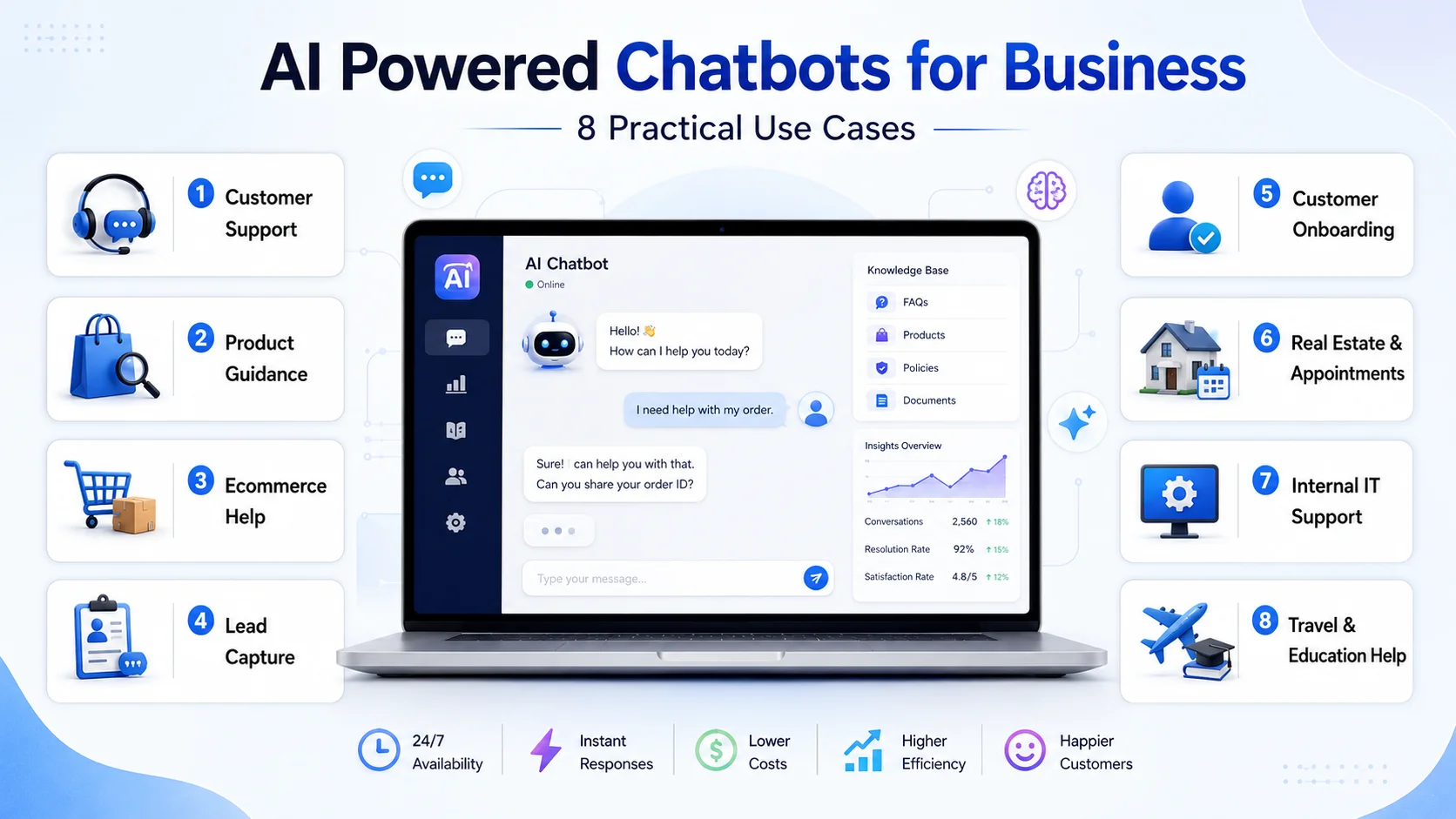
1. Answering Repeated Customer-Support Questions
Customer support is one of the most practical uses of an AI chatbot. Most businesses regularly receive questions about prices, delivery, returns, service areas, account access, product features, bookings or business hours. These questions are important, but answering them manually every time can create unnecessary work.
A chatbot can provide immediate answers using approved FAQs, website content and support documents. This gives customers a self-service option while allowing employees to focus on unusual or complicated cases.
For example, an online customer might ask whether a discounted product can be returned. Instead of searching through the complete returns policy, the customer can receive an answer based on the store’s actual terms. The chatbot should transfer complaints, payment disputes, unusual refund requests and emotionally sensitive situations to a person.
2. Guiding Visitors Towards the Right Product or Service
Visitors do not always know which option matches their needs. A software company may offer several plans. An agency may provide different marketing services. A professional-services firm may work with multiple business types. Even when every option is explained on the website, visitors may still need help applying that information to their situation.
An AI chatbot can ask a few relevant questions and guide the visitor towards suitable information. For example, a visitor might say: “I run a small online store and need help answering customer questions. Which service should I look at?”
The chatbot can explain the relevant service or direct the visitor to the correct page. It should support the decision rather than claim that one option is definitely suitable without enough information. This type of guidance can make a large or complex website easier to use.
3. Helping Ecommerce Shoppers Before They Purchase
Ecommerce shoppers frequently need answers while deciding whether to buy. They may want to compare products, understand sizing, confirm compatibility, check delivery times, find payment information or review return conditions. If these answers are difficult to find, the customer may delay or abandon the purchase.
An ecommerce chatbot can use store content to answer questions and guide product discovery. For example, a shopper may ask: “Which of these backpacks can hold a 15-inch laptop and still fit under an airline seat?”
The chatbot can compare published dimensions, compartments and product features. It should explain the available information without inventing guarantees that do not appear in the product data.
An ecommerce chatbot may also help customers find collections, understand store policies or navigate towards human assistance.
Accessing live stock, customer orders or delivery updates requires the correct integrations. A chatbot should not claim it can complete these actions when it only has access to general website information.
4. Capturing and Qualifying Website Leads
A visitor may be interested in a business but unwilling to complete a long contact form without first asking a question. An AI chatbot can begin with the visitor’s actual requirement and collect lead details naturally during the conversation. Depending on the business, it might ask about the customer’s industry, preferred service, budget range, expected timeline or contact method.
For example, a web-development agency could use a chatbot to determine whether a visitor needs a new website, an ecommerce store or improvements to an existing platform. The sales team can then receive the conversation with useful context instead of only receiving a name and email address.
Lead qualification should remain helpful and transparent. The chatbot should only request information the business genuinely needs and should explain when those details will be shared with a team member.
5. Supporting New-Customer Onboarding
Customers often need the most help immediately after purchasing a product or starting a service. A SaaS customer may need assistance creating an account, connecting an integration, inviting team members or finding documentation. A service client may need to understand what information to provide before a project begins.
An AI chatbot can guide users towards setup instructions, onboarding resources, tutorials and frequently requested next steps. For example, a new software customer might ask: “How do I add another user to my account?” The chatbot can explain the approved process or direct the customer to the relevant documentation.
It should not access or change account information unless it is securely connected to the required system and authorised to perform that action. Good onboarding use cases focus on helping customers understand the process without removing access to human assistance.
6. Managing Real Estate and Appointment Enquiries
Real estate websites often receive repeated questions about location, property type, availability, price range and viewing options. An AI chatbot can collect basic buyer or seller requirements and guide visitors towards relevant listings or contact options. It may ask about the preferred area, property type, budget, number of bedrooms or expected moving date.
For a service business, a similar chatbot may explain appointment procedures, available services, required documents or consultation options. The chatbot can help prepare the enquiry, but actual booking or availability confirmation depends on whether it is connected to the business’s calendar or property system.
When a visitor is ready to discuss a property, negotiate or receive personalised professional advice, the conversation should move to the appropriate person.
7. Providing IT and Internal Employee Support
AI chatbots are not limited to customer-facing websites. Businesses can also use them internally to help employees find information about software access, password procedures, company policies, technical documentation or standard operating processes.
Instead of searching through multiple folders or sending a routine question to the IT team, an employee may ask: “How do I request access to the project management system?” The chatbot can retrieve the approved process from internal documentation and direct the employee towards the next step.
Internal chatbots require careful access controls. Employees should only receive information they are authorised to view, particularly when the knowledge base contains confidential company, customer or HR information. Complicated technical incidents and security concerns should always be escalated to qualified team members.
8. Answering Travel, Education and Information-Based Questions
Travel and education websites often contain large amounts of useful information spread across many pages. A travel customer may ask about destinations, booking policies, luggage rules, cancellations or required documents. A student or parent may ask about courses, admission requirements, application dates, fees or programme structures.
An AI chatbot can make this information easier to access through conversation. For example, a prospective student might ask: “Which documents do international applicants need to submit?”
The chatbot can answer using the institution’s approved admission information and guide the visitor to the relevant application page. Important dates, fees, travel rules and admission requirements can change. The chatbot’s knowledge must therefore be updated whenever the organisation changes its published information.
Multilingual Customer Assistance
Many of these use cases can also support customers in different languages. A multilingual AI chatbot can help international visitors understand products, services, policies, courses or booking information without requiring a separate support team for every language.
However, important translations should still be reviewed carefully. Legal terms, payment conditions, return policies, technical instructions and admission requirements should not depend entirely on an unchecked automated translation. Multilingual support is most useful when it improves accessibility while preserving the accuracy of important business information.
What Makes a Chatbot Use Case Genuinely Useful?
A chatbot should not be added simply because AI is popular. It should address a clear and repeated user need. A strong business use case normally has:
A specific problem to solve
Reliable information the chatbot can use
Clear limits on what it may answer
A human-handoff process
A way to measure results
Regular knowledge updates
For example, “add AI to our website” is not a clear objective. “Answer repeated product and delivery questions outside working hours” is much more practical. Starting with one focused use case makes the chatbot easier to train, test and improve. Additional tasks can be added after the initial experience is working reliably.
When Should the Chatbot Transfer to a Human?
AI should make support easier to access, not create another barrier between the customer and the business. Human assistance is usually required when the conversation involves:
A complaint or emotionally frustrated customer
Payment or billing disputes
Unusual refunds
Custom pricing or negotiation
Sensitive personal information
Complex technical problems
Decisions requiring approval
A direct request to speak with someone
A good handoff should include the previous conversation and information already collected. The customer should not have to explain the entire situation again after being transferred.
The most effective model combines fast AI assistance with human judgment. The chatbot manages suitable conversations, while employees handle situations where empathy, authority or experience adds greater value.
How AgentBest.ai Supports Real Business Use Cases
AgentBest.ai helps businesses create an AI chatbot using their existing website content and additional knowledge. A user enters a website URL so the platform can learn from relevant products, services, FAQs, policies, pricing information and other business pages. Additional PDFs, manuals, support documents and curated knowledge can also be added.
After deployment through a website widget, the AI agent can answer visitor questions, provide product or service guidance, collect leads, assist with customer support, transfer more complex conversations to the business team and many other features.
This allows the same platform to support ecommerce stores, SaaS companies, real estate websites, small businesses, customer-support teams, IT support, travel companies and education websites. The exact chatbot role should still be defined by each business. An ecommerce store may prioritise product and policy questions, while a SaaS company may focus on features, pricing and onboarding.