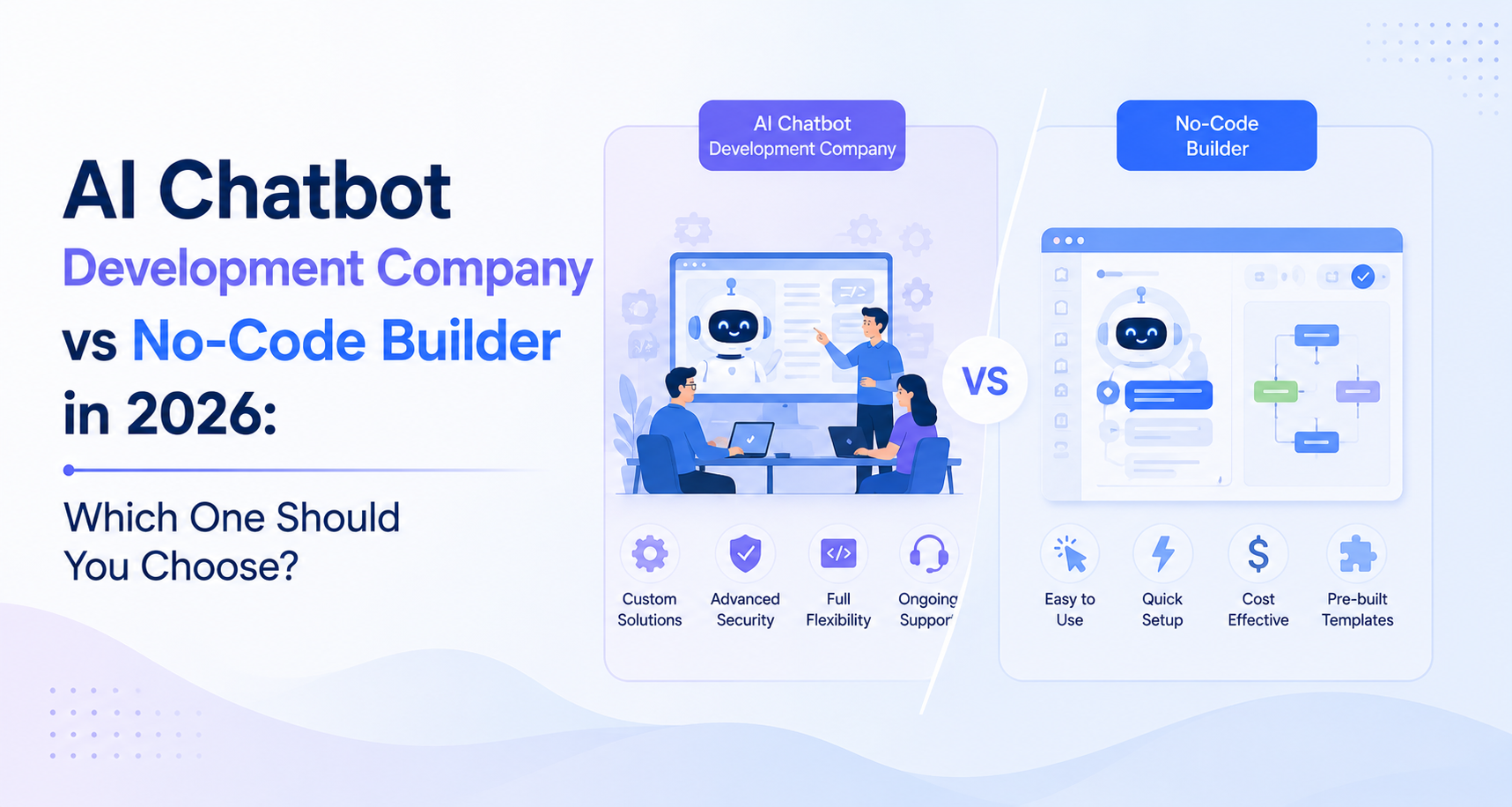
Imagine two businesses that both say: “We need an AI chatbot for our website.” The first wants visitors to ask questions about services, pricing, policies, and FAQs. It also wants to capture leads and transfer difficult conversations to the team.
The second wants the AI to identify logged-in customers, retrieve account information, check subscription status, update its CRM, create support tickets, perform approved actions inside proprietary software, and maintain detailed audit records.
They may both call the project an AI chatbot, but they should probably not build it the same way. The first business may be able to launch with a no-code platform. The second may have a legitimate reason to hire an AI chatbot development company.
That difference matters because custom development can become a serious software investment. Current Clutch data says focused custom chatbot projects can begin around $1,000 to $10,000 minimum project sizes, while enterprise systems can reach $100,000 to $250,000 or more.
A typical custom build may take roughly 8 to 12 weeks, with integrations, proprietary data, security requirements, and testing extending the timeline. Meanwhile, modern no-code tools already provide visual builders, website and document knowledge, integrations, workflows, human escalation, analytics, and deployment without requiring businesses to develop the entire platform themselves.
Botpress, for example, now combines visual workflows, knowledge bases, integrations, web deployment, and human support tools, while Voiceflow provides drag-and-drop workflows for production AI agents. So the real decision is not custom versus cheap. It is how much of your chatbot genuinely needs to be custom.
What Does an AI Chatbot Development Company Actually Do?
An AI chatbot development company builds or integrates a conversational system specifically around a business's requirements. That work can include much more than creating the chat interface.
Clutch describes chatbot development companies as handling areas such as conversational design, proprietary information, CRM and helpdesk integrations, web and messaging channels, testing, deployment, and ongoing tuning. Depending on the project, a development company may work on:
- Requirements and architecture
- User experience
- AI model integration
- Retrieval-Augmented Generation
- Website and document ingestion
- Databases
- Customer authentication
- CRM integrations
- Ecommerce integrations
- Internal APIs
- Business workflows
- AI actions
- Human handoff
- Analytics
- Security
- Monitoring
- Hosting
- Maintenance
This becomes valuable when the chatbot needs to fit the business instead of asking the business to work within the limits of an existing platform.
What Is a No-Code AI Chatbot Builder?
A no-code AI chatbot builder gives you much of that technical foundation as an existing product. Instead of asking developers to create the knowledge system, chatbot interface, dashboard, deployment method, conversation engine, and integrations from scratch, you configure components that already exist. A typical no-code process might look like:
- Add your website or knowledge sources.
- Upload additional documents.
- Configure the chatbot's instructions.
- Define behaviour and escalation.
- Connect supported applications.
- Test conversations.
- Deploy the chatbot.
Botpress currently provides a visual drag-and-drop Studio with workflows, nodes, knowledge bases, tools, integrations, webchat, and human-support functionality. Its knowledge bases can use websites, documents, tables, rich text, integrations, and other sources.
Voiceflow similarly provides a no-code workflow canvas for building conversational logic while supporting integrations and more controlled production workflows. The important point is that no-code does not mean basic anymore. That has changed the point at which custom development becomes necessary.
AI Chatbot Development Company vs No-Code Builder at a Glance
| Area | AI Chatbot Development Company | No-Code Builder |
|---|---|---|
| Initial cost | Usually higher | Usually lower |
| Launch time | Often weeks or months | Often hours or days |
| Coding required | Yes | Usually not for standard setup |
| Technical team | Usually required | Often optional |
| Website knowledge | Custom-built or integrated | Frequently built in |
| Documents / FAQs | Custom architecture | Usually supported |
| Proprietary systems | Strong flexibility | Depends on integrations/API |
| Custom workflows | Very flexible | Increasingly capable, but platform-limited |
| Custom interface | Full control | Usually configurable within limits |
| Authentication | Can be fully customized | Depends on platform |
| AI actions | Can be built specifically | Limited to available actions/integrations |
| Hosting | Custom or managed | Managed by provider |
| Maintenance | Your responsibility or developer's | Core infrastructure managed by provider |
| Source-code ownership | Possible | Usually no |
| Best fit | Unique and deeply integrated systems | Common business chatbot requirements |
Neither side wins automatically. The deciding factor is the requirement.
1. Start With What the Chatbot Needs to Know
Before thinking about development, list the information customers need. It may already exist in:
- Website pages
- Product pages
- Services
- FAQs
- Help-center content
- Pricing
- Policies
- PDFs
- Manuals
- Support documents
If most chatbot conversations can be answered from information like this, a no-code platform may already cover the difficult infrastructure.
Agent Best AI, for example, can scan website pages, products, services, FAQs, pricing information, policies, and other public business content, then combine it with uploaded PDFs, manuals, support resources, and other knowledge.
A visitor might ask: “Does your Growth plan include team collaboration?” Then: “What about multilingual support?”
If those answers already exist in the website or supplied knowledge, building a custom retrieval system simply to answer them may be unnecessary. For this type of use case, a no-code AI chatbot builder deserves to be tested before custom development is commissioned.
2. Then Ask What Systems the AI Needs to Access
This is where the decision often changes. Imagine a customer asks: “What does your refund policy say?” That is knowledge. Now: “Was the refund for my account approved?” That requires customer-specific information. Then: “Please process it for me.” That may require a real business action.
A no-code builder can handle increasingly sophisticated integrations, but there will always be limits around which systems and actions it supports. Botpress, for example, lets agents connect to external APIs, tools, and third-party services so they can retrieve information and trigger actions. Its integration hub includes prebuilt and third-party connectors, while developers can create further integrations when needed.
This can eliminate a lot of custom development. But imagine your company relies on an internal warehouse application written 15 years ago with unusual authentication and no supported connector. If the chatbot must retrieve live information from that system, custom engineering becomes much easier to justify.
3. Custom Development Wins When Your Workflow Is Genuinely Unique
Suppose a logistics company wants an AI agent to process a shipment-change request. The agent needs to:
- Identify the customer.
- Check their contract.
- Find the shipment.
- Review customs status.
- Check destination restrictions.
- Determine whether rerouting is allowed.
- Calculate additional charges.
- Request approval above a certain value.
- Update an internal logistics platform.
- Confirm the change.
That workflow is specific to the company's operations. Trying to force it into a generic chatbot builder could become more complicated than developing the right system.
This is a strong reason to work with an AI chatbot development company. You are not hiring developers because AI chat is technically impressive. You are hiring them because your business logic is not already represented in a standard product.
4. No-Code Usually Wins for Standard Website Conversations
Now consider a different business. Its visitors ask:
- “What services do you offer?”
- “Do you work with Shopify?”
- “How much does the Starter plan cost?”
- “Can someone contact me?”
- “What is your cancellation policy?”
These are common website chatbot requirements. The business may need:
- Website training
- Additional documents
- Natural answers
- Customer support
- Lead capture
- Human handoff
- Analytics
- Multilingual support
Building every underlying component yourself probably adds cost without adding meaningful differentiation. Agent Best AI already provides website crawling, additional knowledge uploads, natural conversations, customer support, lead assistance, human handoff, multilingual support, updates, and analytics as part of its existing platform. For a business with requirements like these, the no-code route should usually be tested first.
5. No-Code Does Not Mean You Are Limited to FAQs
This is an outdated assumption. Modern no-code builders increasingly combine generative conversations with controlled workflows. Botpress uses visual workflows made from configurable nodes and cards. It can also connect knowledge and external tools to those workflows.
Voiceflow's Workflow Builder similarly supports advanced conversational sequences, logic, and integrations through a no-code drag-and-drop environment. Chatbase's current paid plans support AI Actions and integrations with systems such as Shopify, Salesforce, Zendesk, HubSpot, Intercom, Slack, Zapier, and WordPress. This means a company may be able to build:
- Qualification workflows
- Booking flows
- CRM lead creation
- Ecommerce assistance
- Support escalation
- Customer information collection
- API-triggered actions
without commissioning an entirely custom chatbot. The important question is whether the available workflow controls match your specific workflow.
6. Custom Development Gives You More Architectural Control
This remains one of the strongest advantages of hiring a development company. With a custom implementation, you can potentially choose:
- AI models
- Hosting infrastructure
- Database architecture
- Retrieval architecture
- Vector database
- Authentication method
- API design
- Permissions
- Logging
- Data retention
- Deployment environment
- User interface
- Monitoring stack
You can also design around internal security policies rather than accepting the architecture of a SaaS platform.
That control becomes valuable for companies with strict infrastructure, data, performance, or regulatory requirements.
But control has a cost. Someone also has to build, test, secure, maintain, and update all of those decisions.
7. A No-Code Platform Manages Much of the Infrastructure for You
With no-code software, the vendor usually manages the underlying chatbot platform. That may include:
- Hosting
- Model connectivity
- Knowledge infrastructure
- Dashboard
- Widget
- Software updates
- Core analytics
- Platform security
- Deployment tooling
Your team focuses more on the business layer:
- Knowledge
- Instructions
- Conversation testing
- Integrations
- Escalation
- Customer experience
This is one reason no-code can launch much faster. Agent Best AI's current How It Works page, for example, describes a process based on entering a website, uploading additional knowledge, and deploying the agent through a website widget without API configuration or developer support for the standard setup.
That is fundamentally different from commissioning the crawler, knowledge system, dashboard, widget, and AI application independently.
8. Compare Development Time Properly
A custom chatbot is a software project. Current Clutch guidance places many custom chatbot builds around 8 to 12 weeks, although simple projects may launch faster and complex enterprise builds may take longer. The main variables include integrations, proprietary information, security review, and testing depth. A custom project may involve:
- Discovery
- Architecture
- User experience
- Prototype
- Knowledge system
- Integrations
- Backend development
- Frontend development
- Testing
- Security
- Deployment
A no-code implementation avoids much of that because the product already exists. You still need to configure and test it properly, but you are not starting from an empty repository. If being live quickly matters, that difference can be significant.
9. Compare Cost Beyond the First Invoice
The custom quote is not the only cost. A custom AI chatbot may also need ongoing spending for:
- Developers
- Hosting
- AI model usage
- Databases
- Vector storage
- Monitoring
- Logging
- API services
- Maintenance
- Security updates
Clutch currently shows how widely initial development costs vary, from focused minimum projects to enterprise implementations costing well into six figures. A no-code platform usually replaces much of that with subscription pricing.
Chatbase, for example, currently lists monthly plans at $40, $150, and $500, with functionality and usage allowances increasing by tier. Agent Best AI currently lists its website chatbot starting from $49 per month and offers a 14-day free trial without requiring a credit card.
These prices are not directly comparable with custom development because the scope is different. The correct comparison is: Total cost of operating the required solution for several years. Not: Custom project quote versus first month's SaaS subscription. For the broader financial breakdown, see AI Chatbot Development Cost in 2026.
10. Source-Code Ownership Can Matter
Custom development can give a company ownership or direct control over its application code, depending on the contract. That can be valuable if:
- The chatbot becomes strategically important
- You want to host it yourself
- You need freedom to change vendors
- You expect substantial future customization
- AI is becoming part of your core product
But do not assume “custom” automatically means “we own everything.” Ask who owns:
- Source code
- Cloud accounts
- Databases
- Deployment accounts
- API credentials
- Documentation
- Knowledge pipelines
- Analytics data
A poorly structured custom project can leave you just as dependent on an agency as a SaaS subscription leaves you dependent on a software provider.
11. No-Code Creates Vendor Dependency Too
A no-code platform has an obvious trade-off. You depend on its:
- Pricing
- Usage limits
- Features
- Integrations
- Models
- APIs
- Export options
- Product roadmap
If an integration disappears or pricing changes, your business may need to adapt. That does not automatically make no-code a bad choice. Every business software platform creates some vendor dependency.
The practical question is whether the speed and reduced technical responsibility are worth that dependency for your use case. For many standard website chatbots, they are.
12. Think Carefully About Security Before Giving AI Actions
The architecture decision becomes more serious when the chatbot can change real systems. For example: “How can I cancel my subscription?” is informational. “Cancel my subscription.” is an action.
A custom build can give engineers very specific control over authentication, authorization, confirmations, logging, and system permissions.
No-code builders may also support controlled actions, but you need to evaluate exactly how those actions are secured. The key principle is simple: Do not give the AI broader access than the task requires.
A chatbot answering public website questions does not need write access to your CRM. A support agent retrieving an account status does not automatically need permission to delete the account.
13. Human Handoff Matters in Both Approaches
The AI should not be expected to handle every conversation. Imagine: Customer: “What is your refund policy?” The AI explains it. Customer: “Your team rejected my refund, but the product arrived damaged.” The conversation has changed.
A person may need to review evidence or make an exception. No-code platforms increasingly provide human-support features. Botpress Desk, for example, is designed for monitoring conversations, handling escalations, and letting a person step in.
Agent Best AI also provides AI-to-human handoff when personal help, complex support, or sales follow-up is needed. With a custom chatbot, the development company can design the handoff specifically around your support stack.
The important question is not whether the platform has a “human handoff” checkbox. Ask what actually happens after the handoff. Does the employee receive the chat history? Customer information? Reason for escalation? Previous troubleshooting steps? That determines whether the experience feels connected.
14. Custom UI Is Another Reason to Hire a Development Company
Most no-code chatbot builders give you a configurable chat widget. For many websites, that is enough. But your product may require something completely different. For example, you may want an AI assistant:
- Embedded inside your SaaS dashboard
- Shown beside a data table
- Integrated into a product configurator
- Built into a mobile application
- Displayed inside proprietary software
- Connected with custom interactive components
This is a stronger reason to consider custom development. If the chatbot itself becomes part of the product experience rather than simply sitting in the corner of the website, interface control can become strategically important.
15. Analytics Can Be Built or Bought
No-code platforms often already include conversation analytics. Agent Best AI currently provides analytics around chatbot activity, common questions, engagement, leads, and AI-assisted conversations.
Botpress also includes conversation analysis with topic summaries, sentiment information, and insights into whether user questions were resolved. Custom development gives you the freedom to build exactly the reporting you want. For example, your business might need:
- Resolution by product line
- Escalation by customer tier
- Cost per automated workflow
- API failure rate
- Revenue from AI-assisted leads
- Internal support usage by department
The trade-off is predictable. Custom analytics give you greater specificity. Prebuilt analytics give you a much faster starting point.
When Should You Hire an AI Chatbot Development Company?
Hiring a development company becomes much easier to justify when one or more of these conditions apply.
- You Have Proprietary Systems
The chatbot needs to work with internal software that standard platforms do not support.
- The AI Must Perform Unusual Actions
Your workflow does not fit common CRM, ecommerce, helpdesk, or booking actions.
- Authentication Is Complex
Users, roles, permissions, or data access rules require a custom approach.
- AI Is Part of Your Product
The assistant needs to live deeply inside your SaaS platform, mobile app, or proprietary software.
- You Need Specialized Infrastructure
Your company has specific hosting, network, data residency, or deployment requirements.
- You Need Full Interface Control
A normal chatbot widget is not suitable.
- You Need Extensive Ownership
The business wants more direct ownership of the software and architecture. In these cases, a capable AI chatbot development company can provide meaningful value.
When Should You Choose a No-Code Builder?
A no-code platform is usually the better first option when your requirements mainly involve:
- Website Q&A
- FAQs
- Product information
- Service information
- Pricing questions
- Customer support
- Lead capture
- Website navigation
- Document knowledge
- Product discovery
- Multilingual conversations
- Human handoff
- Common integrations
You are solving a common problem. There is very little reason to rebuild all the infrastructure if an existing platform already handles it reliably. For businesses exploring this route, the Best No-Code AI Chatbot Builders in 2026 compares several current approaches.
The Hybrid Approach Is Often Better Than Either Extreme
This is the option businesses sometimes miss. You do not have to choose: 100% no-code or 100% custom. Imagine an existing platform already gives you:
- Website crawling
- Business knowledge
- Chat interface
- Analytics
- Human handoff
- Team management
But you also need access to one proprietary internal system. You could keep the standard infrastructure and build only the missing integration. This avoids paying developers to recreate everything. Many modern no-code platforms are designed with this expansion path in mind.
Botpress combines no-code Studio workflows with APIs and extensible integrations, while Voiceflow combines visual building with production integrations and broader technical controls. For many businesses, this hybrid model provides the best balance between speed and flexibility.
Three Realistic Examples
Example 1: Local Service Business
The company needs a chatbot to answer:
“What services do you offer?”
“Which areas do you cover?”
“How much does this service cost?”
“Can someone call me?”
Recommended starting point: No-code builder. Most required information already exists on the website. Custom development would probably add cost without improving the customer experience enough to justify it.
Example 2: Ecommerce Store
The store needs:
- Product discovery
- Shipping questions
- Returns
- Product comparisons
- Support handoff
Recommended starting point: No-code or existing ecommerce chatbot. Now add:
- Authenticated order changes
- Warehouse-specific stock
- Custom loyalty calculations
- Proprietary fulfilment software
- Complex return approval
Recommended direction: Hybrid or custom development. The requirement has moved beyond straightforward website knowledge.
Example 3: Enterprise SaaS Platform
The chatbot must:
- Identify logged-in users
- Understand account permissions
- Retrieve subscription data
- Troubleshoot product issues
- Update Salesforce
- Create Jira tickets
- Modify approved settings
- Log every action
- Meet internal infrastructure requirements
Recommended direction: AI chatbot development company, enterprise agent platform, or a hybrid architecture with significant custom engineering. Here, the AI is becoming part of the company's product and operational infrastructure.
How to Evaluate an AI Chatbot Development Company
Do not start by asking which models the company uses. Give the provider a real workflow. For example:
“A customer asks to cancel their subscription. The account is under contract, but the customer says they were charged incorrectly. What would your chatbot do?” A strong provider should discuss:
- Customer authentication
- Account data
- Contract information
- Knowledge retrieval
- Business rules
- Billing integration
- Escalation
- Permissions
- Logging
A weak provider may spend most of the answer talking about how powerful its AI model is. Models matter. But architecture, data, integrations, permissions, and workflow design usually determine whether the system works in the real business.
Questions to Ask Before Hiring a Development Company
| Area | Question |
|---|---|
| Use Case | What exact customer problems are included in the scope? |
| Knowledge | How will the AI use our website, documents, and internal information? |
| Integrations | Which systems are included in the proposal? |
| Actions | What can the AI actually perform? |
| Authentication | How will customer identity be verified? |
| Accuracy | What happens when information is missing or contradictory? |
| Security | How will permissions and sensitive data be protected? |
| Handoff | What happens when AI cannot resolve the issue? |
| Testing | How will realistic conversations and failure cases be evaluated? |
| Analytics | What will we be able to measure? |
| Ownership | Who owns the code and infrastructure? |
| Maintenance | Who maintains integrations and AI infrastructure after launch? |
| Operating Cost | What recurring model, cloud, and support costs should we expect? |
A useful proposal should answer these questions clearly.
How to Evaluate a No-Code Builder
The evaluation process should be different. Do not spend your trial asking generic questions such as: “What is artificial intelligence?” Use your actual business. Test:
- “does growth plan include 5 users?”
- “where do you explain cancellations?”
- “i need something under $100”
- “already tried that still not working”
- “can i talk to someone?”
Then evaluate:
- Accuracy: Is the information correct?
- Context: Does it understand follow-up messages?
- Knowledge: Is it using your actual business content?
- Boundaries: Does it avoid inventing answers?
- Integration: Can it connect to the systems you need?
- Handoff: Can a person take over properly?
If a no-code platform passes those tests, you need a strong business reason to replace it with custom development.
Where Agent Best AI Fits
Agent Best AI sits on the no-code side of this decision, with room for businesses to expand beyond a simple FAQ chatbot. The platform lets businesses provide a website URL, automatically scan relevant pages, products, services, FAQs, policies, and other business information, add supporting documents, and deploy an AI assistant through a website widget.
Its current capabilities include website crawling, custom knowledge, customer support, lead assistance, human handoff, multilingual conversations, knowledge updates, and analytics. This makes Agent Best AI a practical option when your goal is to make existing business knowledge easier for website visitors to access without commissioning the entire chatbot platform from scratch.
If your requirements move into deeply proprietary workflows, specialized authentication, or unusual internal systems, that is the point where custom development becomes more reasonable. You can review how Agent Best AI works or its current AI chatbot features before deciding how much custom engineering your project actually requires.
Is Hiring an AI Chatbot Development Company Worth It?
It can be. But only when custom engineering solves a real constraint. Paying developers to recreate website crawling, document uploads, a chatbot widget, basic analytics, and standard human handoff rarely makes sense if an existing platform already meets your requirements.
Paying developers to integrate AI deeply into proprietary systems, authenticated workflows, internal software, or a unique product experience can make much more sense. That is the dividing line. Not company size. Not whether custom software sounds more professional. Not whether AI agents are currently fashionable. The requirement should determine the architecture.
Final Thoughts
Choosing between an AI chatbot development company and a no-code builder is really a decision about complexity. A no-code builder makes sense when the chatbot mainly needs to understand your website and documents, answer visitor questions, provide customer support, capture leads, guide customers, and use common integrations.
A development company becomes more valuable when the chatbot needs to work deeply inside proprietary systems, authenticate users, perform unusual actions, follow specialized business logic, use custom interfaces, or meet specific infrastructure requirements. And for many businesses, the best answer sits somewhere in the middle.
Use an existing platform for the capabilities that are already solved. Build only the integrations and workflows that are genuinely unique. Before making the decision, write down three things:
- What does the chatbot need to know?
- Which systems does it need to access?
- What is it actually allowed to do?
Those answers will tell you much more than a sales demo. The smartest chatbot project is not the one with the most custom code. It is the one that uses custom development only where custom development creates real business value.
=========================================================